
Google AI Overviews: What They Are, How They Work & How to Optimise for Them
A practical guide to how Google AI Overviews work, what they mean for SEO, and how UK businesses can improve visibility without chasing AI-search myths.
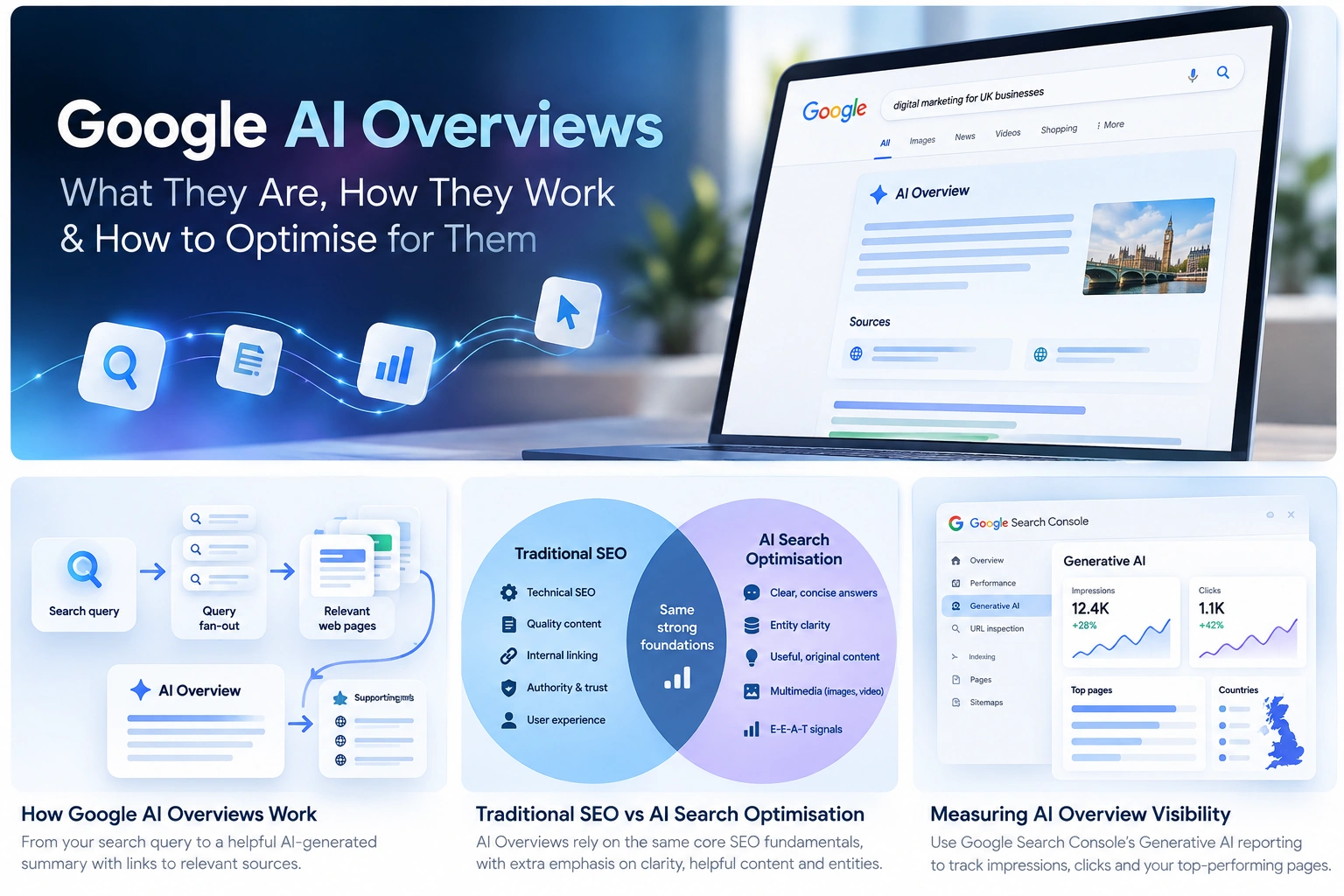
Quick answer: Google AI Overviews are AI-generated summaries that can appear above or among traditional search results when Google believes a generated response will help people understand a topic more quickly. For website owners, there is no separate “AI Overview ranking system” to optimise with a secret tag or file. Google’s current guidance is to keep doing strong SEO: make important pages crawlable and indexable, publish useful original content, make information easy to understand, support it with trustworthy signals, and measure whether your pages are actually gaining visibility.
That matters for UK businesses because search behaviour is changing without making the fundamentals obsolete. A potential customer might still click a standard result, but they may also start with an AI Overview, follow one of its supporting links, refine the query, compare options, or move between Search and other AI-assisted experiences. The practical goal is therefore not to “game AI”. It is to make your website a strong, useful source that can compete across both classic and generative search.
What are Google AI Overviews?
Google AI Overviews are generated summaries designed to help people get the gist of a more complex question or topic before exploring further. They can include links to supporting web pages so users can continue their research. Google says AI Overviews are shown when its systems judge that they add value beyond the standard search results, which is why they do not appear for every query.
From an SEO point of view, the important detail is that AI Overviews still depend on the wider Google Search ecosystem. The pages referenced as supporting links come from content Google can discover, process and consider useful. There is no separate submission queue where a business can simply “send” a page to AI Overviews.
For a small or growing UK business, this creates both a challenge and an opportunity. A broad informational query may receive more of its answer directly on the results page, which can reduce some simple informational clicks. At the same time, AI-assisted search can expose users to pages and brands they might not have discovered through a traditional ten-blue-links journey. The aim should be to earn useful visibility at the right stage of that journey, not chase every possible AI mention.
How do Google AI Overviews work?
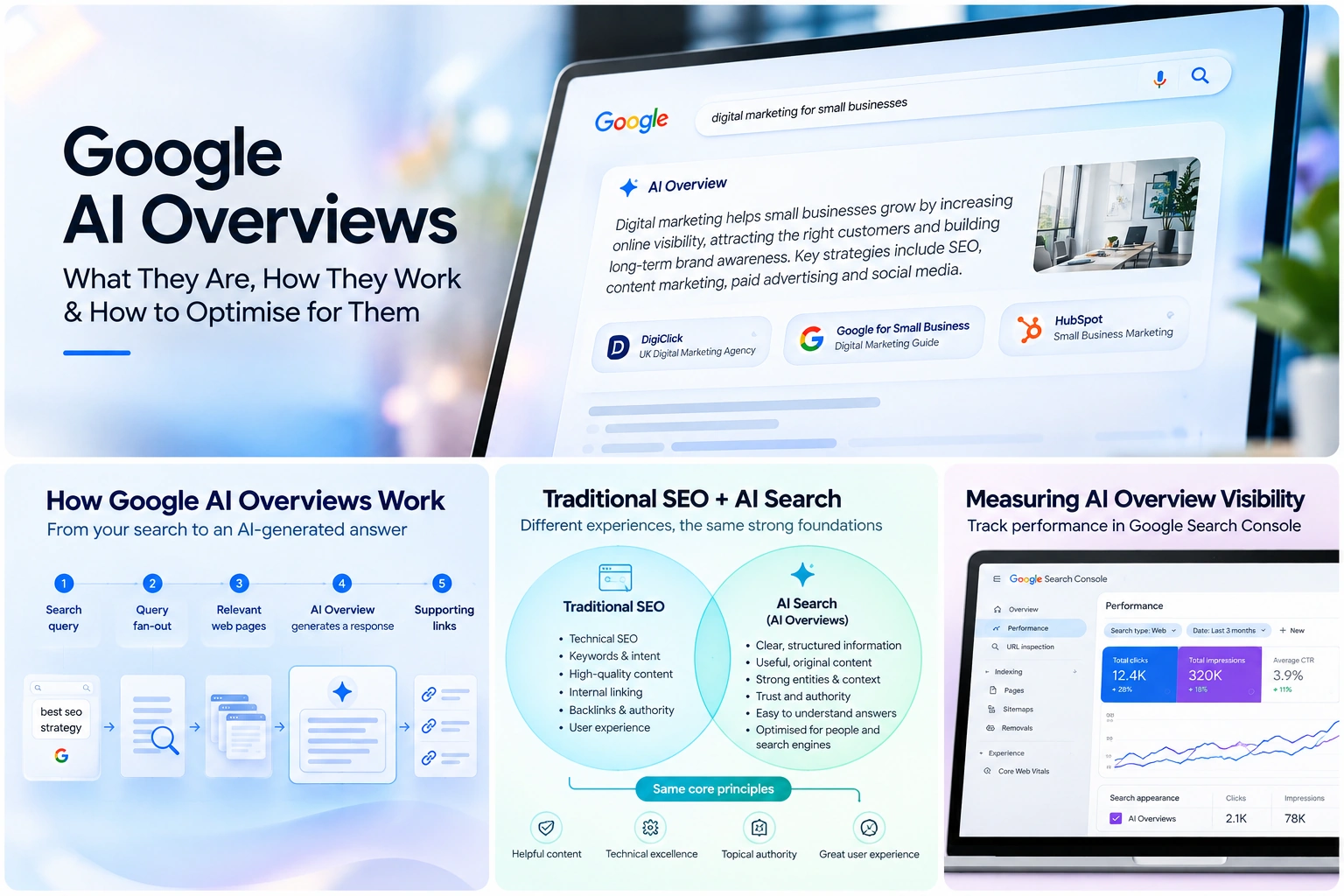
Google does not publish a simple checklist of “AI Overview ranking factors”, and it would be misleading to pretend one exists. What Google does explain is the broad process. Its generative AI systems can use a technique called query fan-out: the system generates several related searches around parts of a user’s question, retrieves relevant information, and then uses that material to build a more helpful response with links to supporting pages.
A simplified version looks like this:
- A user asks a question. The wording may be broad, conversational or more specific than a traditional short keyword.
- Google explores related subtopics. Query fan-out can help the system research different parts of the question rather than relying on one exact phrase.
- Relevant pages are retrieved from Search. Technical eligibility still matters: pages need to be discoverable, indexed and eligible to appear with a snippet.
- The system builds a response. Google’s models combine the retrieved information into an answer intended to help the user move forward.
- Supporting links give users routes to the web. These links can send people to pages that provide more detail, evidence, examples or a next action.
This is one reason exact-match keyword obsession is becoming less useful. If a page clearly answers the real problem, Google’s systems can understand relevance without every possible phrase being repeated word for word. That does not mean keyword research is dead. Search demand, language and intent still matter because they help you understand what people want. It means keyword research should guide a useful page, not dictate an unnatural script.
Are Google AI Overviews changing SEO?
Yes, but not in the way some “SEO is dead” headlines suggest. Google’s 2026 guidance is explicit that foundational SEO remains relevant for generative AI search. From Google Search’s perspective, work described as AEO or GEO still sits on top of the same search foundations: technical accessibility, relevance, useful content, clear site structure and trustworthy information.
The bigger change is the search experience. A person can receive a partial answer before clicking, ask a longer question, compare several options in one session or see different supporting sources than they would in a classic result set. That can change which content earns attention and how success should be measured.
For businesses, the practical response is to make content easier to use and easier to trust. A thin page built only around a target phrase has less strategic value than a page that answers the question clearly, includes useful evidence, connects to relevant services, and helps the reader take the next step.
How to optimise for Google AI Overviews
There is no guaranteed formula for appearing in an AI Overview. Google says that even pages meeting its requirements and best practices are not guaranteed to be crawled, indexed or shown. The best approach is therefore to improve the underlying quality and eligibility of your site rather than optimise for a fictional “AI score”.
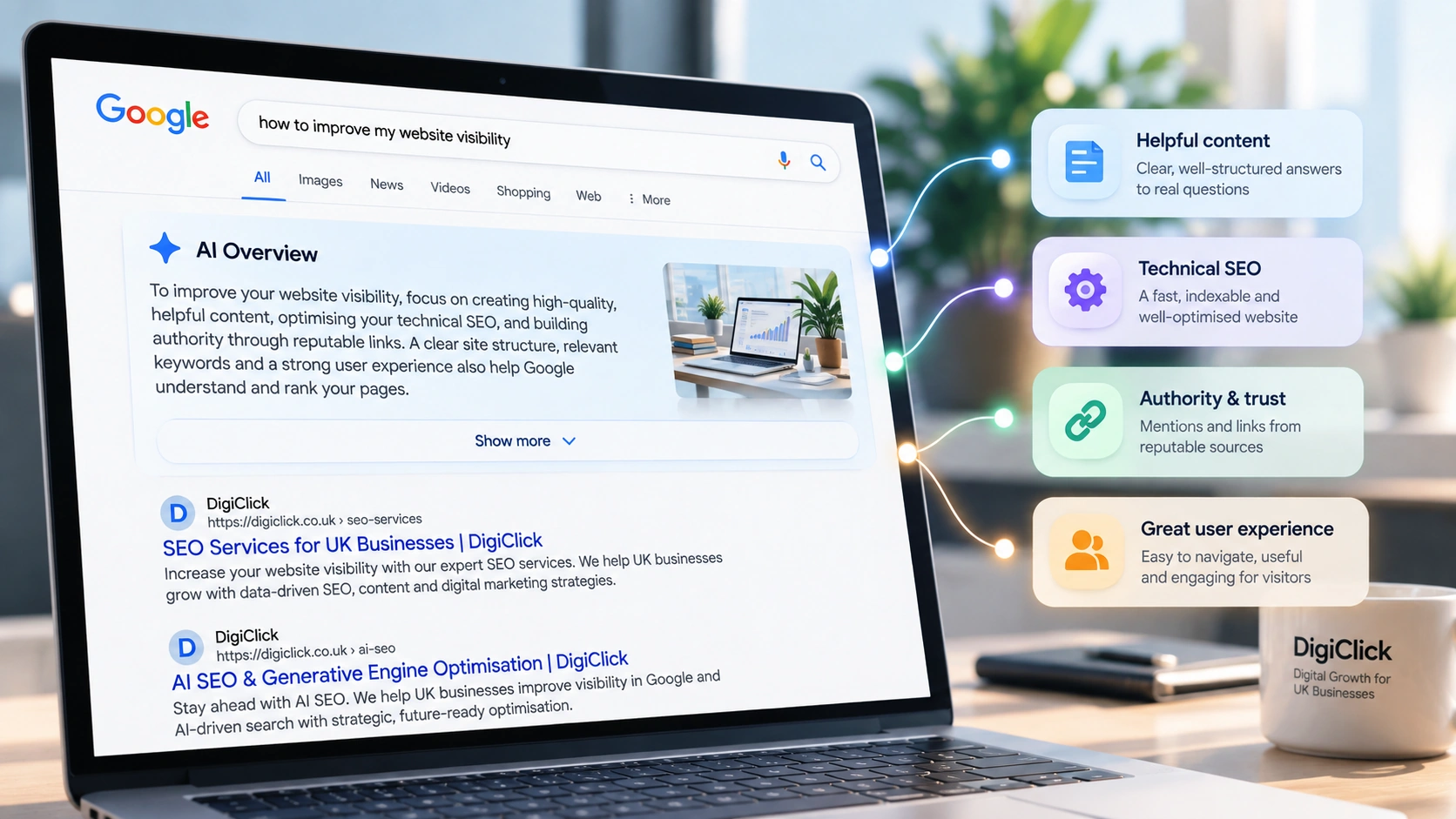
- Make important pages technically eligible. Ensure pages can be crawled, indexed and shown in Google Search with a snippet. Review robots rules, canonicals, noindex directives, sitemap coverage and internal linking before looking for exotic AI tactics.
- Match the real search intent. Understand whether the user wants an explanation, comparison, checklist, service, product or decision support. A useful answer begins with solving the right problem.
- Provide original value. Add practical experience, examples, first-party data, expert interpretation, clear recommendations or useful context that is not simply a rewrite of the pages already ranking.
- Answer important questions clearly. Use descriptive headings, concise explanations and logical sections. Clear writing helps people first; it also makes the page easier for search systems to process.
- Strengthen internal relationships. Connect informational content to relevant commercial and supporting pages. For example, a guide about AI Overviews can naturally link to AI SEO and Generative Engine Optimisation when the reader wants implementation support, and to SEO services when discussing the technical foundations.
- Use relevant images and video where they improve understanding. Google’s current generative AI guidance recommends strong multimedia when it genuinely supports the topic. Visuals should explain something, not exist only to decorate the page.
- Keep structured data accurate. Schema can still support normal Search features and help describe entities, but there is no special AI Overview schema that unlocks generative visibility.
- Measure visibility and business outcomes. Do not judge the strategy only by whether you can manually trigger an AI Overview. Track Search Console visibility, landing-page traffic, enquiries and the quality of the journeys that follow.
What you do not need for Google AI Overviews
The rapid growth of AI search has produced a large number of supposed shortcuts. Some are harmless experiments; others can distract teams from more valuable work. Google’s current guidance is unusually direct about several of them.
- You do not need a special AI schema. Continue using relevant structured data for the normal reasons, but there is no separate schema.org markup required for Google’s generative AI features.
- You do not need an
llms.txtfile for Google Search. Google clarified in June 2026 that these files are not needed for Google Search and do not improve or hurt visibility or rankings there. Other services may choose to use them, so maintaining one can still be a separate technical decision. - You do not need to split every article into tiny “AI chunks”. Google says its systems can understand nuance across a page. There is no ideal page length for generative search; length should follow the audience and the topic.
- You do not need a page for every fan-out variation. Creating large numbers of near-duplicate pages simply to capture every possible related query can become scaled content abuse and is not a sustainable strategy.
- You do not need to rewrite normal language into robotic “AI-friendly” prose. Useful, natural content is the safer target. Search systems can connect concepts and synonyms without exact phrase repetition everywhere.
This is an important distinction for businesses buying AI SEO or GEO services. Good work should make your site technically sound, clear, useful and easier to evaluate. It should not depend on a secret markup file or a promise that a provider can guarantee citations inside an AI Overview.
Traditional SEO vs AI search optimisation: what actually changes?
For Google, the overlap is larger than the difference. The same website still needs a crawlable architecture, strong pages, useful content and trustworthy signals. AI-assisted search increases the importance of clarity and breadth because the system may explore several related aspects of a complex question before choosing supporting sources.
| Area | Traditional SEO focus | AI-assisted search emphasis |
|---|---|---|
| Technical access | Crawlability, indexation, canonicals, snippets | The same technical eligibility remains essential |
| Intent | Match the query and SERP purpose | Also handle broader conversational questions and subtopics |
| Content | Useful, relevant pages that satisfy the search | Clear, original information that can support a synthesized answer |
| Authority | Trust, links, reputation and demonstrated expertise | The same trust signals remain valuable; fake mentions are not a shortcut |
| Measurement | Rankings, impressions, clicks, leads and revenue | Add generative AI visibility and source-page analysis where data is available |
At DigiClick, we treat AI SEO and Generative Engine Optimisation as an extension of strong SEO rather than a replacement for it. That keeps the work grounded in things a business can actually improve and measure.
How to measure Google AI Overview visibility
Measurement has improved significantly in 2026. Google introduced dedicated Search Generative AI performance reporting in Search Console in June and, as of 31 August 2026, says the insights have rolled out to websites worldwide.
The dedicated reports can show visibility information such as:
- Impressions from generative AI features in Search and Discover.
- Pages that appeared within AI features.
- Countries where that visibility occurred.
- Devices for Search visibility.
- Dates so performance can be analysed over time.
That is more useful than repeatedly searching your own keyword and taking screenshots. AI features can vary by query, user context, device and time. A single manual check cannot tell you how visible the whole site is.
Use Search Console together with marketing analytics and web analytics. Search Console tells you how Google surfaces the site; GA4 and lead tracking help you understand what visitors do after they arrive. For a lead-generation business, a useful measurement chain is:
AI/Search visibility → landing-page visit → engaged session → enquiry or lead → qualified opportunity.
Be cautious with attribution. A rise in AI visibility does not automatically prove that AI Overviews caused every new lead. The goal is to build a consistent evidence trail over time rather than attach certainty to one screenshot or one week of data.
What should UK businesses do now?
If you are responsible for a UK business website, you do not need to rebuild your entire SEO strategy around AI Overviews. A better plan is to audit what already exists and fix the highest-impact gaps first.
- Confirm your key commercial pages are technically healthy and indexable.
- Map the questions customers ask before they enquire or buy.
- Create or improve content that answers those questions with genuine depth.
- Link informational content to the correct service or product owner page.
- Add useful visuals, examples, evidence and first-hand insight where possible.
- Use Search Console’s generative AI reporting as a baseline, then review it over time.
- Measure leads and commercial outcomes rather than treating AI visibility as the end goal.
If your site already has strong SEO foundations, this may be an evolution rather than a separate project. If the foundations are weak, chasing AI citations before fixing crawlability, page ownership or content quality usually puts the work in the wrong order.
If you want help identifying the practical gaps, DigiClick can review the current setup and recommend whether the priority should be technical SEO, content, measurement or a broader AI SEO and GEO strategy. The starting point should be evidence, not a promise of guaranteed AI placement.
Frequently asked questions about Google AI Overviews
What are Google AI Overviews?
Google AI Overviews are generated summaries that can appear in Search when Google believes a synthesized answer will help users understand a topic or question. They can include links to supporting pages for further reading.
How do Google AI Overviews work?
Google says AI Overviews can use query fan-out, where the system runs several related searches around parts of a question, retrieves relevant information and builds a response with supporting web links.
Can you optimise a website for Google AI Overviews?
You can improve a website’s eligibility and usefulness, but there is no guaranteed AI Overview optimisation formula. Google recommends the same foundations as Search: technical eligibility, helpful reliable content, clear structure and useful supporting information.
How can my website appear in Google AI Overviews?
A page must first be indexed and eligible to appear in Google Search with a snippet. After that, Google decides whether and when a page is useful as a supporting source. Meeting the requirements does not guarantee inclusion.
Do I need special schema for AI Overviews?
No. Google says there is no special schema.org markup required for generative AI search. Structured data can still be valuable for its normal SEO uses when it accurately reflects visible page content.
Does llms.txt help with Google AI Overviews?
Not for Google Search. Google clarified in 2026 that llms.txt is not needed for Google Search and does not improve or reduce Search visibility or rankings. Other AI services may make their own choices about whether to use such files.
Is AI SEO different from traditional SEO?
There are additional considerations around conversational queries, entity clarity, answer structure and AI visibility measurement, but Google’s own guidance treats strong SEO as the foundation. AI SEO should build on technical SEO, content quality and trust rather than replace them.
Can an SEO agency guarantee that my site will appear in an AI Overview?
No credible agency can guarantee that. Google explicitly notes that meeting its technical requirements and best practices does not guarantee crawling, indexing or serving. A sensible service should improve your site’s eligibility, usefulness and measurable search visibility without promising control over Google’s generated results.
